

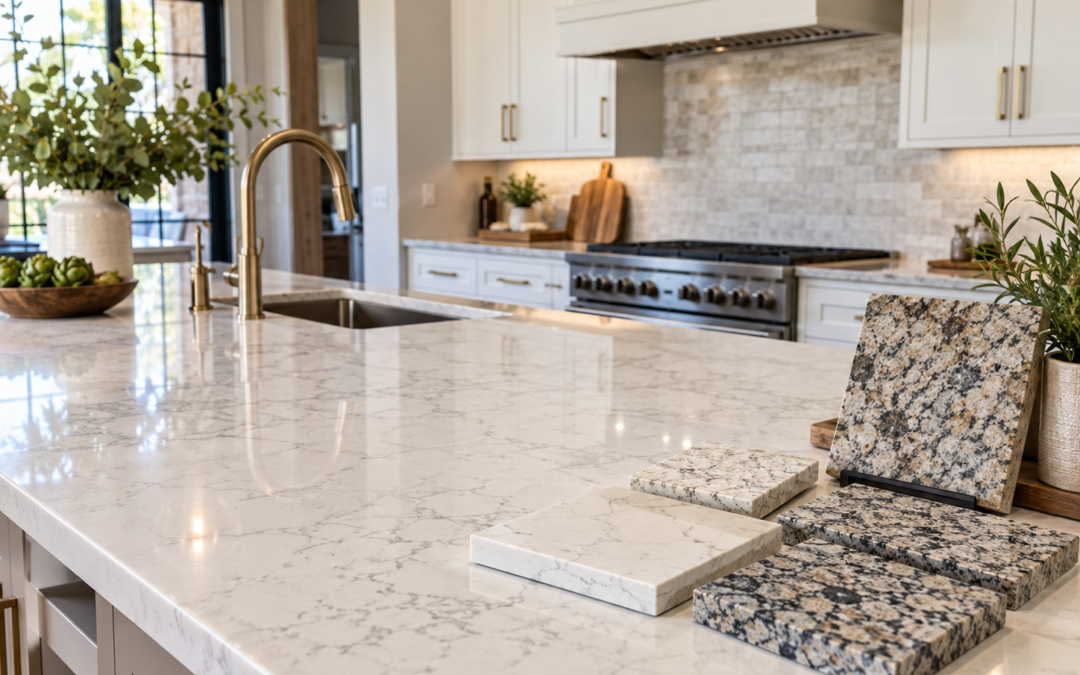
Choosing countertops is one of the biggest design decisions in a kitchen remodel.
Your counters need to handle meal prep, spills, hot cookware, appliances, entertaining, and everyday wear while also tying together your cabinets, backsplash, flooring, and lighting.
For many homeowners, the decision comes down to two popular materials: quartz and granite.
So, which is better?
There is no universal winner. Quartz is often preferred for its low maintenance, consistent appearance, and wide range of colors. Granite appeals to homeowners who want natural stone, one-of-a-kind patterns, and excellent heat resistance.
The best choice depends on how you use your kitchen and what matters most to you.
Here is how quartz and granite compare.
What Is the Difference Between Quartz and Granite Countertops?
Although they can look similar once installed, quartz and granite are very different materials.
Granite Countertops
Granite is a natural stone quarried from the earth, cut into slabs, polished, and fabricated to fit your kitchen.
Because it is a natural material, every slab is unique. Veining, mineral deposits, color variation, and pattern changes are all part of its appearance.
Quartz Countertops
Quartz countertops are engineered surfaces made using natural quartz minerals combined with resins and pigments.
This manufacturing process allows quartz to offer a more consistent appearance and a much broader range of colors and patterns, including designs that resemble marble or other natural stone.
If you are planning a kitchen remodel, both materials can work beautifully. The key is deciding which characteristics fit your household better.
Quartz vs. Granite: Which Requires Less Maintenance?
For many homeowners, maintenance is where quartz has the advantage.
Quartz is nonporous, so it does not typically need to be sealed. Everyday cleaning usually requires mild soap, water, and a soft cloth.
Granite is porous to varying degrees and may require periodic sealing to help protect against staining and moisture absorption.
If you want a countertop that requires as little ongoing maintenance as possible, quartz may be the more convenient choice.
Quartz May Be Better If You Want:
- No routine sealing
- Easy everyday cleaning
- Strong stain resistance
- A more predictable maintenance routine
Granite May Be Better If You:
- Prefer natural stone
- Do not mind occasional sealing
- Are comfortable following stone-care recommendations
- Value unique slab variation over low maintenance
Which Is More Durable: Quartz or Granite?
Both quartz and granite are highly durable countertop materials.
That is one reason they are so commonly used in kitchens.
Quartz Durability
Quartz is highly resistant to scratches, stains, and chips under normal household use.
Because it is engineered, the material tends to have a consistent structure throughout the slab.
However, quartz contains resin, which means it can be more sensitive to excessive heat than natural stone.
Using trivets or heat-resistant pads under hot cookware is a good habit.
Granite Durability
Granite is extremely hard and handles heat very well.
It is also resistant to scratching under normal kitchen use, although no countertop is indestructible.
Because granite is natural stone, certain edges or areas within a slab may be more vulnerable to chipping than others.
For most households, either option provides excellent long-term durability when properly installed and maintained.
Which Is Better for Stain Resistance?
Quartz generally has the advantage.
Because quartz is nonporous, liquids are less likely to penetrate the material.
That can be helpful in a busy kitchen where countertops regularly encounter:
- Coffee
- Wine
- Cooking oils
- Tomato sauce
- Juice
- Food coloring
Granite can also resist staining well, particularly when properly sealed.
The difference is that granite's stain resistance depends more on the specific stone and the condition of its seal.
If low-maintenance stain resistance is one of your top priorities, quartz may be the better fit.
Which Countertop Is Better Around Heat?
Granite generally performs better when exposed to heat.
As natural stone, granite tolerates high temperatures very well.
Quartz, on the other hand, contains resin that may discolor or become damaged if exposed to excessive heat.
That does not mean quartz is a poor choice for someone who cooks frequently. It simply means you should avoid placing extremely hot pots and pans directly on the countertop.
Using trivets protects either material and is a good practice regardless of which one you choose.
Quartz vs. Granite: Which Looks Better?
This is entirely subjective.
Why Homeowners Choose Granite
Granite is ideal if you appreciate natural variation.
No two slabs are exactly alike. Depending on the stone, granite may contain:
- Dramatic veining
- Mineral flecks
- Subtle movement
- High-contrast patterns
- Organic color variation
That uniqueness is a major part of its appeal.
Why Homeowners Choose Quartz
Quartz gives you significantly more control over the finished look.
Manufacturers offer designs ranging from very simple solid surfaces to dramatic marble-inspired patterns.
Quartz can be particularly helpful when you are trying to coordinate countertops precisely with cabinetry, tile, flooring, and other finishes.
If you prefer consistency and predictability, quartz may be easier to design around.
If you prefer natural variation and one-of-a-kind character, granite may be more appealing.
Which Is Better for a Busy Family Kitchen?
Quartz is often a strong choice for busy households because of its low maintenance and stain resistance.
If your kitchen sees constant activity, that can be valuable.
Quartz may be a good fit for households with:
- Children
- Frequent cooking
- Heavy countertop use
- Lots of entertaining
- Limited time for maintenance
Granite is also very durable, but homeowners need to be comfortable maintaining the stone correctly.
The decision usually comes down to whether you value easier maintenance or natural stone more.
Which Countertop Is Better for Resale Value?
Both quartz and granite are widely recognized as premium countertop materials.
Either can be attractive to future buyers when the countertop complements the kitchen and has been properly maintained.
Rather than choosing one material exclusively for resale, it usually makes more sense to select the countertop that works best with the overall kitchen design.
A cohesive kitchen with thoughtfully selected materials will generally make a stronger impression than one chosen around a single trend.
For more planning considerations, read our guide to designing a kitchen that actually works for you.
Quartz vs. Granite Cost: Which Is More Expensive?
The cost of both materials varies significantly.
Price can depend on:
- Manufacturer or stone variety
- Slab thickness
- Color and pattern
- Rarity
- Edge profile
- Number of seams
- Countertop size
- Cutouts for sinks and appliances
- Installation complexity
Entry-level quartz may cost less than a rare granite slab, while a premium designer quartz may cost more than many granite options.
Instead of assuming one is always cheaper, compare the specific materials you are considering.
The countertop is only one part of your remodeling budget, so it should be evaluated alongside cabinetry, flooring, appliances, lighting, plumbing fixtures, and labor.
What About Seams?
Large kitchens often require more than one slab of material.
That means seams may be necessary whether you choose quartz or granite.
Quartz patterns tend to be more consistent, which can sometimes make seams easier to visually coordinate.
Granite requires careful slab selection and placement because natural veining and pattern variation can make seam matching more complicated.
An experienced fabricator will plan the countertop layout to make seams as discreet as reasonably possible.
Which Works Better With White Cabinets?
Both.
White cabinetry is versatile enough to work with almost any countertop material.
Quartz can create a very clean, contemporary appearance, especially with subtle gray veining or soft neutral tones.
Granite can add more organic movement and contrast to an otherwise simple white kitchen.
The better choice depends on the overall style you want:
- Clean and streamlined: quartz
- Natural and textured: granite
- Soft transitional: either
- Traditional: granite or warm quartz
- Modern: quartz often works particularly well
Before making a final selection, compare countertop samples directly against your cabinet color, flooring, backsplash, and lighting.
Do Countertops Affect Kitchen Lighting?
More than many homeowners expect.
Glossy or light-colored countertops can reflect light around the room, while darker surfaces tend to absorb more of it.
Veining and pattern can also appear very different depending on whether the kitchen uses warm or cool lighting.
That is one reason countertop selection should happen alongside your overall lighting plan.
Our guide to task, ambient, and accent lighting explains how layered lighting affects both functionality and the appearance of your finishes.
Quartz vs. Granite at a Glance
| Feature | Quartz | Granite |
|---|---|---|
| Maintenance | Low | Moderate |
| Sealing | Usually not required | May require sealing |
| Stain Resistance | Excellent | Very good when sealed |
| Heat Resistance | Good, but use trivets | Excellent |
| Appearance | Consistent and customizable | Natural and unique |
| Color Options | Very broad | Depends on natural stone |
| Durability | Excellent | Excellent |
| Natural Material | Engineered | Yes |
So, Which Countertop Is Better?
Choose quartz if you prioritize:
- Low maintenance
- Strong stain resistance
- Consistent patterns
- Broad color choices
- Easy everyday care
Choose granite if you prioritize:
- Natural stone
- Unique patterns
- Excellent heat resistance
- Organic variation
- A one-of-a-kind surface
Neither material is automatically better.
The right countertop is the one that fits your design, maintenance preferences, cooking habits, and budget.
Planning a Kitchen Remodel in Connecticut?
Countertops should not be selected in isolation.
They need to work with your cabinetry, appliances, lighting, flooring, backsplash, storage, and overall layout.
At CT Shower & Bath, we help Connecticut homeowners plan kitchens around both function and style. From cabinetry and countertop selection to lighting, storage, and complete remodeling, our team can help bring all of those decisions together into one cohesive space.
Explore our kitchen remodeling services, browse our kitchen remodeling gallery, or contact CT Shower & Bath to start planning your project.