

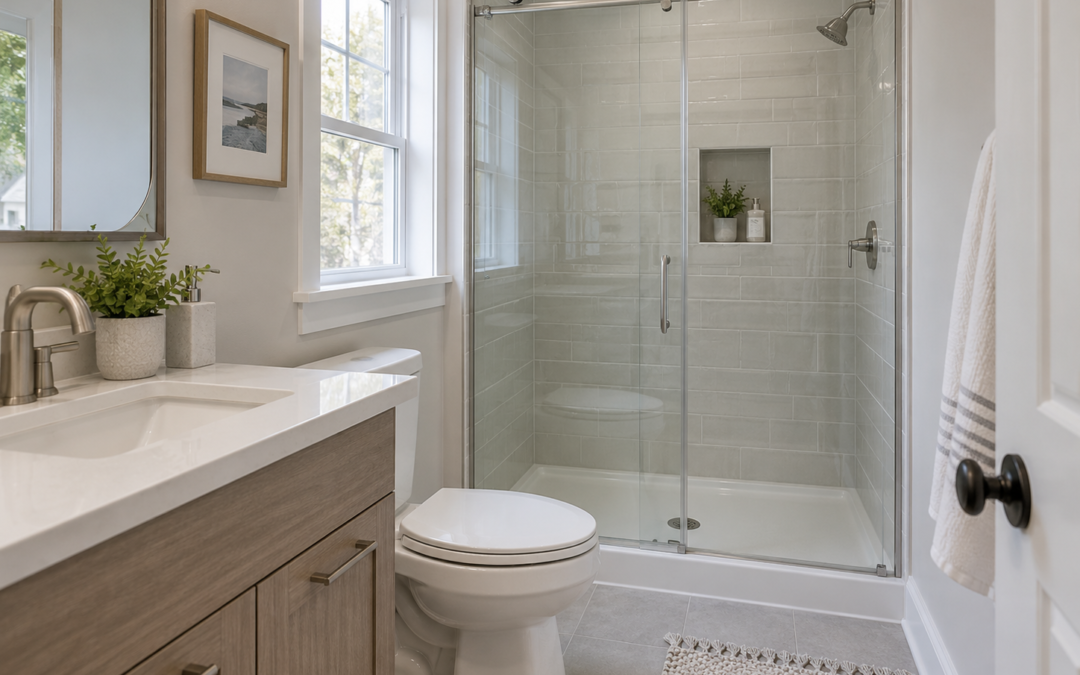
When every inch of your bathroom matters, the wrong shower door can make an already tight space feel even smaller.
A door that swings into the vanity, bumps into the toilet, or blocks the main walkway is more than an inconvenience. It can affect how comfortably you use your bathroom every single day.
So, what is the best shower door for a small bathroom?
For many compact bathrooms, a sliding glass shower door is one of the best options because it does not require additional floor space to open. However, it is not the only solution. Depending on your shower dimensions and bathroom layout, a frameless swinging door, fixed glass panel, or custom corner enclosure may be an even better fit.
The key is choosing the enclosure around the space you actually have rather than trying to force a standard shower door into it.
Why Shower Door Style Matters in a Small Bathroom
In a large primary bathroom, there is usually enough room to accommodate several types of shower doors. Smaller bathrooms are less forgiving.
Before choosing an enclosure, consider:
- The distance between the shower and toilet
- Vanity and cabinet placement
- Bathroom entry door clearance
- Shower width and depth
- Where the shower fixtures are positioned
- The direction a hinged door would swing
- How easily you can enter and exit the shower
- How much water needs to be contained
- Whether you want the bathroom to feel more open
Glass itself can be particularly helpful in a smaller room. Unlike a shower curtain or heavily framed enclosure, clear glass keeps your sightline open and allows you to see the full depth of the shower. That can help a compact bathroom feel less visually divided.
CT Shower & Bath specifically offers custom frameless enclosures designed to exact openings, and notes that frameless glass can make both the shower and the overall room feel larger.
1. Sliding Shower Doors: Often the Best Choice for Tight Spaces
If floor space is your biggest challenge, start by considering a sliding shower door.
Instead of opening into the bathroom, the glass panels travel horizontally along the shower opening. This eliminates the clearance required for a traditional swinging door.
Sliding doors are particularly useful when:
- A toilet sits close to the shower
- The vanity is directly beside the enclosure
- The bathroom has a narrow walkway
- A hinged door would interfere with another fixture
- You want a larger glass enclosure without sacrificing usable floor space
Older sliding shower doors were often associated with bulky metal tracks and heavy framing. Modern options can look significantly cleaner.
CT Shower & Bath offers frameless sliding doors that eliminate much of the metal found on traditional sliding enclosures, making them particularly well suited to tight bathrooms.
Best for: Small or narrow bathrooms where there is little room for a door to swing.
2. Frameless Swinging Doors: Great When You Have Just Enough Clearance
A small bathroom does not automatically rule out a swinging shower door.
If your layout provides enough clearance, a custom frameless hinged door can create an especially clean, open appearance. With minimal metal surrounding the glass, there are fewer visual barriers breaking up the room.
This can work well in a small bathroom where:
- The toilet and vanity are positioned away from the shower entrance
- The shower opening is relatively narrow
- There is adequate clearance for the door
- You prefer a minimal, high-end appearance
The important part is measuring the entire door path, not just the shower opening.
A beautiful enclosure will become frustrating quickly if its door nearly hits a vanity every time you use it.
Because CT Shower & Bath's frameless shower doors are cut to the exact opening, the enclosure can be designed around the dimensions of the specific bathroom rather than relying exclusively on standard sizes.
Best for: Small bathrooms that still have sufficient swing clearance.
3. A Fixed Glass Panel Can Make a Bathroom Feel Bigger
Sometimes the best shower door is no door at all.
A fixed glass panel can partially enclose a walk-in shower while leaving one side open for entry. With no hinges, handles, or sliding mechanism required at the entrance, the design can look exceptionally simple.
It can also preserve your sightlines from one end of the bathroom to the other.
However, fixed-panel showers need to be designed carefully. The shower needs enough depth and the glass needs to extend far enough to help contain splashing. Showerhead direction also matters.
For that reason, this solution is not automatically appropriate for every small shower.
Best for: Walk-in showers with enough depth to control water without a full door.
4. Corner and Neo-Angle Enclosures Can Reclaim Floor Space
What if your shower itself is taking up too much of the bathroom?
A corner enclosure can be designed to use an otherwise awkward portion of the room. Some configurations use angled glass instead of building the shower as a simple square or rectangle.
That can help maintain showering space while reducing how far the enclosure projects into the room.
CT Shower & Bath highlights corner units as a useful solution for space-conscious bathrooms because they can be configured around compact layouts.
These designs are especially useful when you are completing a larger bathroom remodel and have more freedom to rethink the existing shower footprint.
Best for: Very compact bathrooms or unusual floor plans.
5. Frameless vs. Semi-Frameless: Which Makes a Small Bathroom Look Larger?
Both can work well.
A frameless enclosure relies primarily on heavy glass panels with discreet hardware rather than a prominent metal frame. Visually, this creates fewer boundaries around the shower.
A semi-frameless enclosure incorporates some structural metal while still providing cleaner lines than a traditional fully framed shower.
CT Shower & Bath offers both configurations.
If the primary goal is making a small bathroom appear as open as possible, clear frameless glass is often the strongest aesthetic choice. If budget and function are higher priorities, a semi-frameless option may provide a good balance.
Should You Use Clear or Frosted Glass in a Small Bathroom?
Clear glass usually gives a small bathroom the most open appearance because your eye continues through the enclosure to the shower wall.
That means a beautiful tile installation effectively becomes part of the room instead of being hidden behind a curtain or opaque barrier.
Frosted or patterned glass offers additional privacy, but it creates a stronger visual boundary.
Neither choice is inherently better. It depends on whether openness or privacy matters more for that particular bathroom.
If you are unsure, explore CT Shower & Bath's glass enclosure gallery to compare different configurations in finished spaces.
Don't Forget About the Bathroom Door
One of the easiest mistakes to make is evaluating the shower by itself.
A small bathroom contains several moving components:
- The bathroom entry door
- The shower door
- Vanity drawers and cabinet doors
- Linen cabinets
- Toilet clearance
All of these need to coexist.
For example, you might technically have enough room for an outward-swinging shower door, but not when the bathroom entry door is open.
That is why accurate measurements and layout planning matter so much in compact bathrooms.
What Is the Best Shower Door for a Tub?
If you are keeping your bathtub, sliding glass doors are often a practical space-saving choice because they stay within the footprint of the tub.
If you rarely use the bathtub, however, it may be worth asking whether the existing tub is making your bathroom less functional.
A tub-to-shower conversion can replace the tub with a larger dedicated shower, potentially creating more comfortable access while giving you additional flexibility with the glass enclosure.
The right decision depends on your household, bathroom dimensions, and whether maintaining a bathtub is important elsewhere in the home.
How Do You Make a Small Shower Look More Luxurious?
The enclosure itself can make a surprisingly large difference.
Consider combining:
- Clear frameless glass
- Minimal hardware
- Large-format wall tile
- Recessed shower niches
- Coordinated fixture finishes
- Built-in or floating seating
- Good overhead lighting
- A handheld showerhead
- Glass protection for easier maintenance
Keeping materials visually consistent also helps. Too many competing tile patterns, metal finishes, borders, and frame elements can make an already small room feel busier.
A simple glass enclosure lets the craftsmanship inside the shower become the focal point.
Custom vs. Standard Shower Doors for Small Bathrooms
Standard-size shower doors work well when the opening happens to match the available dimensions.
Small or unusually configured bathrooms often benefit more from a custom enclosure.
Custom glass allows the design to account for:
- Non-standard openings
- Angled walls
- Partial walls
- Benches
- Sloped ceilings
- Unusual shower footprints
- Nearby vanities and toilets
- Specific hardware placement
CT Shower & Bath has specialized in glass enclosures since 1992 and designs, fabricates, and installs framed, semi-frameless, and frameless options. Installations are performed by the company's associates, and custom frameless doors are cut to the individual opening.
So, Which Shower Door Is Best for Your Small Bathroom?
There is no single answer for every bathroom, but these are good starting points:
| Your Bathroom Challenge | Consider |
|---|---|
| Very little swing clearance | Frameless sliding door |
| Vanity or toilet beside shower | Sliding door |
| Enough room for a door to open | Frameless hinged door |
| Deep walk-in shower | Fixed glass panel |
| Awkward corner layout | Custom corner or neo-angle enclosure |
| Want the room to look larger | Clear frameless glass |
The best shower door for a small bathroom is ultimately the one that uses the available space efficiently without making the room feel crowded.
Find the Right Glass Enclosure for Your Connecticut Bathroom
A compact bathroom does not mean you have to settle for a bulky shower enclosure.
With the right measurements and configuration, custom glass can make a smaller room feel brighter, cleaner, and significantly more open.
CT Shower & Bath has specialized in glass enclosures for more than three decades and offers everything from modern frameless sliding doors to custom hinged and semi-frameless designs.
Explore our glass enclosure options, browse our completed glass projects, or contact CT Shower & Bath to discuss the best shower door for your bathroom.
Not sure what will physically fit? Bring your measurements or photos to our West Hartford showroom, and our team can help you compare your options.